
Physical vs Visible Aging, Chapter 2: Section 2. From The Biology of Skin Aging, Part One: The Twelve Hallmarks of Aging.
Section two describes the primary hallmarks of aging that affect skin: genomic instability, telomere attrition, and epigenetic alterations.

Section 2. The Hallmarks of Skin Aging
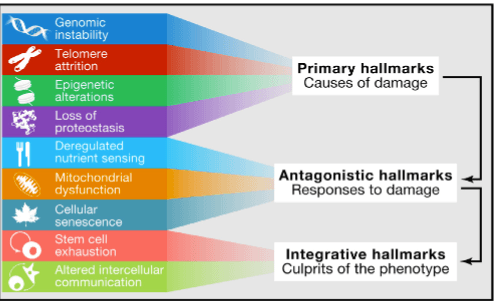
While the aging hallmarks apply across the entire body some are more important than others when it comes to skin. Foremost is the fact that skin ages differently than other tissues and cell populations due to UV exposure. Photoaging and the prominent role played by ECM (extracellular matrix) in breakdown and repair modes sets skin and its aging processes apart in studies of aging biology. Three of the primary hallmarks of aging have a direct connection with skin aging, as do certain antagonistic hallmarks that occur in response to alterations in normal function, such as mitochondrial dysfunction and cellular senescence. Let’s begin our discussion with some aging basics.
Illustration #2. Primary Hallmarks of Aging
1) Genomic instability
Most researchers attribute damage to DNA as the primary cause of aging. Deoxyribonucleic acid or DNA is a molecule composed of two strands that coil around each other to form a double helix. The long, twisted strands contain the genetic information that governs the growth, development, functioning and reproduction of all known living organisms. A gene is a segment of DNA, packaged as a unit called a chromosome, that transmits traits from parent to offspring. DNA carries instructions in a succession of letters A, G, C, T that show the order of nucleotides, but replication leads to errors that accumulate as we age. Indeed, our DNA is constantly under attack, as each time a cell copies its DNA one of our 46 chromosomes is broken, altogether amounting to over two trillion breaks per day. (4) Damage to and imperfect repair of DNA causes cellular mutations which can be passed on to the cells they in turn create.
Besides endogenous threats such as replication errors and damage from reactive oxygen species (ROS) other threats comes from external sources (exogenous), including non-ionizing radiation from UV light, microwaves, radio waves and cell phones, and, as we move up the electromagnetic spectrum into the higher energy range, damage from ionizing radiation via x rays and CAT scans as well. UVC light, another form of ionizing radiation, is blocked by the ozone layer in most areas, but where the layer is thin the damage can be extensive. In Australia, where the ozone layer is thin, the percentage of people over age forty who have skin cancer is…100%. Even relatively low UVC exposure could account for some of this high rate, as no protective measure exists that will stop ionizing radiation. It travels unseen and can pass through tissue, and it has the capacity to remove electrons from atoms and molecules in the matter through which it passes. Ionizing activity can alter molecules within the cells of our bodies, meaning that where the threat exists it can make a large contribution towards destabilizing the genome.
The largest contribution by far to skin aging remains exposure to the non-ionizing radiation from UVA and UVB –these are the rays we exposed to daily that cause skin burns, premature aging of the skin, eye damage and skin cancer. 90 to 95% of wrinkles and the majority of skin cancers are caused by UV exposure. Radiation exposure and its role in skin aging as well as what can be done about it is explored extensively in later chapters.
To summarize: damage to DNA from all sources accrues, and if not corrected, compromises physical and mental functioning. Damage to cellular DNA from UV exposure constitutes the major source of skin aging.
Antagonistic Hallmark: Mitochondrial Dysfunction
Mutations and deletions in aged mitochondrial DNA also contribute to aging, though causes are unclear. It was assumed that the oxidative microenvironment of mitochondria would contribute the most towards generating mtDNA mutations in aged cells, but contrary to expectations they appear to be caused by replication errors early in life rather than oxidative damage. We do know that UVA exposure leads to modifications, i.e., large deletions in the mitochondrial genome, that are commonly observed in photo-aged skin. UV damage goes as deep, affecting mitochondrial DNA, as it goes wide, affecting cellular DNA.
2) Telomere Attrition
Blackburn and others (5) found that cells age when the length of the telomeres in the cells shortens.
Telomeres are the caps at the end of each strand of DNA. They protect our chromosomes, rather in the way plastic tips on the ends of shoelaces prevent the laces from fraying. Telomeres are especially susceptible to age-related deterioration since telomere shrinkage happens each time the cell duplicates itself. This is because, in a beautiful example of entropy, the enzyme that replicates DNA, called DNA polymerase, works in only one direction across the DNA strand. No reversing direction! At the end of the replication process the DNA polymerase detaches from the DNA, leaving a tiny gap that is normally filled by the enzyme telomerase. Since telomerase is less expressed by cells the telomeres shorten over each replication.
Antagonistic Hallmark: Cellular Senescence
Telomere attrition contributes to cell replicative senescence and inflammation eventually leading to chronic inflammation.
Most mammalian somatic cells do not express telomerase, which leads to the progressive and cumulative loss of telomere protective sequences from chromosome ends. Short telomeres lose their histone packaging, exposing the DNA at the end of the chromosome. Attempts at repair result in increasing and cumulative disorder, eventually leading to telomere exhaustion. Telomere exhaustion explains why some cells, most notably fibroblasts (the cells in the dermis that create more skin cells) have limited proliferative capacity. This was first demonstrated by Leonard Hayflick in 1965. The limit fibroblasts can duplicate themselves properly is about 40 to 60 times before senescence sets in.
Cellular senescence is a prominent feature of aging skin because as soon as senescent cells cease to divide normally they begin to secrete a cocktail of inflammatory signals called senescence-associated secretory phenotype (SASP). In younger people senescent cells are quickly removed, but as we age they accumulate in the body, releasing tiny proteins called cytokines which create chronic inflammation. Inflammation is so central to age-related diseases it has given rise to the term “inflammaging.”
When it comes to skin the obvious shorthand term becomes skinflammaging, and the phenomenon can certainly be seen all around us in the general population. Indeed, I don’t know of anyone who doesn’t suffer some degree of skinflammaging. Replicative senescence, telomere attrition, the Hayflick limit and SASP play such an enormous role in skin aging, aka skinflammaging, that it is my belief that the future of skin care lies in devising effective responses to these particular challenges. We will revisit the response challenge in later sections of the book.
3) Epigenetic alteration
Research in another field—epigenetics—is poised to change the way we look not just at aging in general, but skin aging in particular. But before we go there let’s ask the question: Just what is epigenetics?
Epigenetics means literally 'on top of' genetics. It refers to heritable changes that are not actually encoded in the DNA, but nevertheless do play an important role in how your genes express themselves. For instance, epigenetics explains why a skin cell looks different from a muscle cell or a liver cell. Though all three cells contain the same DNA, their genes are expressed differently (turned 'on' or 'off'), which turns them into very different types of cells.
A variety of epigenetic mechanisms switch genes to “on” or “off” --just like a light switch, only there are a lot of them going on and off all the time. The exciting news is that although epigenetic changes are heritable in somatic cells, these epigenetic modifications are also potentially reversible. Scientists are exploring this potential for reversal in areas such as cancer prevention and treatment, as well as its significance in our area of interest—skin aging.
It appears that against a background of epigenetic alterations affecting all cells and tissues throughout life, many genes show altered expression during the aging process. This explains the interest many researchers have shown in the long-term effects of environmental stress on gene expression regulation during aging. Some of the most-studied epigenetic mechanisms include DNA methylation, histone modifications and non-coding RNAs.
Antagonistic Hallmark: Deregulated Nutrient Sensing
Nutrient sensing is the mechanism by which cells recognize and respond to energy substrates, and gene variants occurring in pathways sensing nutrient abundance or scarcity can be indicators of aging. For example sirtuins, proteins that signal nutrient scarcity, are decreased in fibroblasts of photo-aged individuals. The downregulation of proteins like sirtuins can occur alongside upregulation of the protein mTOR kinase, which signals a state of nutrient abundance.
The good news is that a growing body of evidence supports the contention that diet, dietary techniques like intermittent fasting as well as environmental factors can directly influence epigenetic mechanisms in humans. Dietary polyphenols from green tea, turmeric, soybeans, broccoli and others have shown to possess multiple cell-regulatory activities within cancer cells. More recently, we have begun to understand that some of the dietary polyphenols may exert their chemopreventive effects in part by modulating various components of the epigenetic machinery in humans.
Diet, nutrition and supplements play key roles in either accelerating or retarding certain aging processes governed by methylation and histone modification. This begs the question to researchers of just how much micronutrient therapy, as well as combinations of topical-internal supplementation and changes in eating patterns, can delay aging effects.
I will repeat this ad nauseum so I am sure the message gets across; with regard to skin, UV exposure far outweighs other factors, even within the framework of epigenetic alterations. Epigenetically speaking, photoaged epidermal tissue shows loss of methylation of cytosine bases and changes in histone modification related to chromatin. In addition, UV induced ROS (reactive oxygen species) directly trigger de-methylation. But epigenetics aside, most skin aging pathways begin with genomic instability, ie. DNA damage, as the primary cause of aging.
Bottom line: Most researchers attribute damage to DNA as the primary cause of aging. Most skin experts attribute DNA damage via non-ionizing radiation exposure as the primary cause of skin aging.
Footnotes to Chapter 2
1. op cit Sinclair p. 119.
2. The Hallmarks of Aging; Carlos Lopez-Otin et al Cell, Volume 153, Issue 6, June, 2013 https://www.cell.com/fulltext/S0092-8674(13)00645-4
3. The Hallmarks of Aging: an expanding universe Carlos López-Otín 1 2 3, Maria A. Blasco 4, Linda Partridge 5 6, Manuel Serrano 7 8 9, Guido Kroemerhttps://www.sciencedirect.com/science/article/pii/S0092867422013770#:~:text=We%20propose%20the%20following%20twelve,exhaustion%2C%20altered%20intercellular%20communication%2C%20chronic4. Op cit Sinclair p.355. https: //embryo.asu.edu/pages/telomeres-and telomerase-cellular-aging-senescence